Daily pet-parent updates
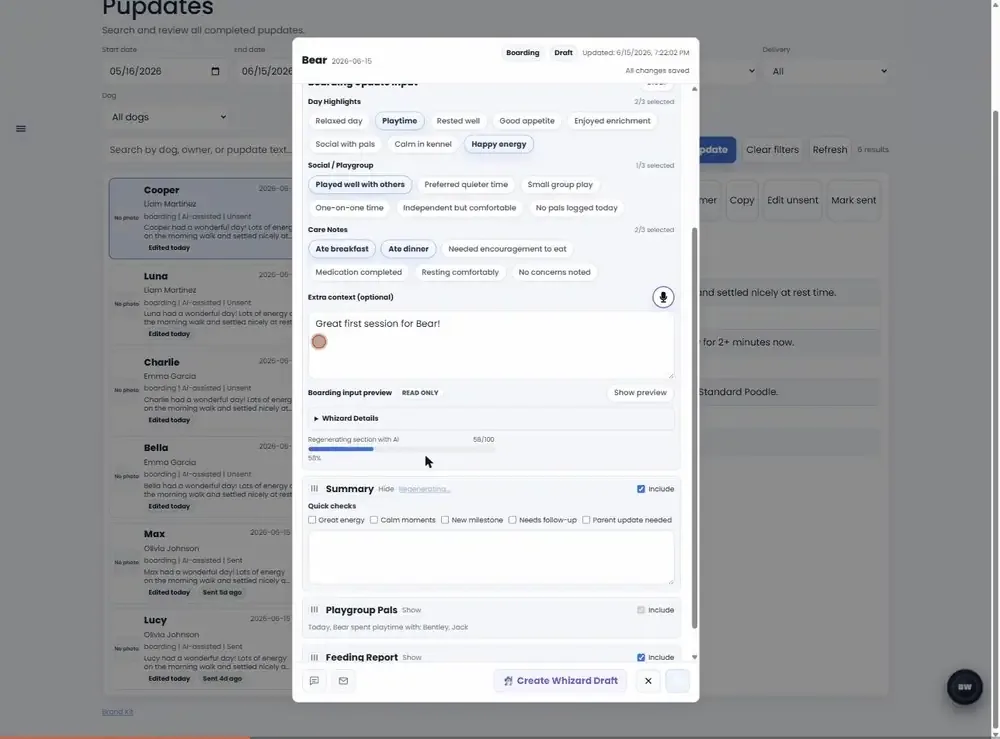
The day's logged care — the feeding, the play, the new friend — becomes a warm first draft per dog. Your team reads it, adds a photo, and sends. Every family hears how their dog did, even on a slammed day. See AI updates →
There's a lot of noise about AI in pet-care software right now — most of it promising a robot that runs your business. That's not what we built. BarkWhiz uses AI for one honest job: drafting the busywork. It turns the care you already logged into a friendly first draft, so your team isn't typing the same note twenty times a day. The individual, one-to-one messages always get a person's review before they send — and you decide what's automated. Here's exactly where we use it, and the lines we won't cross.
One rule runs through all of it: AI drafts, a human decides.
We use AI where it's genuinely good — turning things you already recorded into readable words — and nowhere near the calls that need a person who knows the dogs. The bespoke, one-to-one messages get a person's review before they send; routine, transactional messages run on rules you set up and approve. Either way, you decide what's automated. Every AI feature here is live today, part of the operational core. See it running →
No mystery, no "AI-powered everything" sticker. Two places, both live, both the same pattern: the AI writes a first draft from what your team already logged, and a person takes it from there.
The day's logged care — the feeding, the play, the new friend — becomes a warm first draft per dog. Your team reads it, adds a photo, and sends. Every family hears how their dog did, even on a slammed day. See AI updates →
The lapsed regular, the meet-and-greet that needs a nudge, the thank-you after a first stay. BarkWhiz drafts the relationship message so it's minutes of work, not a blank box — then it waits for your team to review and send. See the Staff CRM →
Because the drafts are built from care your team already logs, the AI never invents a day that didn't happen. It reshapes the real notes into something a pet parent wants to read — grounded in the truth of the day, not made up. See care logging →
The most important part of an AI feature is the part it refuses to do. Here's the line, drawn plainly.
The judgment that keeps dogs safe and clients trusting you isn't drudgery to automate away — it's the job. AI takes the typing off your team's plate so they have more attention for the calls only a person can make.
“AI” covers a lot of ground. The drafting above is generative AI — a language model, powerful but capable of being wrong, so a person always reviews it. Other parts of BarkWhiz are rule-based AI: deterministic expert systems that follow logic you can check and can't hallucinate. We'd rather name which is which than sticker everything “AI-powered.”
It's a deterministic expert system — it matches dogs to runs on size, weight, capacity, and service tier using logic you can check, not a language model's guess. It can't hallucinate: if a dog doesn't fit anywhere, it says so instead of inventing an answer. How the Whizard works →
Booking confirmations, vaccine expirations, pickup nudges — those run on plain rules and templates you control, not a language model. It's automation, not generative AI, and we won't dress it up as something cleverer than it is. See reminders →
Not every message needs a person to hit send — but the ones that carry your voice do. Our rule of thumb: predictable and transactional can run on its own; bespoke and individual waits for a human. You decide where the line sits.
Routine, transactional messages run on rules you set up and approve once — today that's appointment reminders and booking confirmations. They're predictable, you own the triggers, and they don't need a person clicking send every time. As we add more of these workflows, they'll always be ones you switch on and configure — never a surprise.
The bespoke, one-to-one messages — a note about how a specific dog's day went, a tailored re-engagement — are drafted by AI and reviewed by a human before they send. That's where your voice and judgment live, so that's where a person always stays in the loop.
"Ten-plus years running pet care taught me where the minutes go — and it's not the hard calls. It's typing the same update forty times, chasing the follow-up you meant to send. That's the drudgery AI is genuinely good at, so that's where I put it.
What I'd never hand a machine is the judgment: which dogs group, who needs the quiet run, what a worried owner actually needs to hear. My team keeps all of that. The AI just makes sure they're not too buried in typing to do it well."
Straight talk on the data
BarkWhiz uses a third-party AI provider to generate drafts from your facility's activity. We don't sell your data and we don't use it to train AI models, and the AI's bespoke, individual messages get a person's review before they send. Routine, transactional messages send automatically on rules you set up and approve; the individual ones wait for a human. Want the details? We'll walk through exactly how the AI features handle data on a call — see our security & data page for the short version.
Everything above is the AI built into BarkWhiz. If your team already lives in an assistant like Claude or Codex, you can connect it to BarkWhiz instead of switching windows — it pulls a live shift brief or your vaccine gaps and drafts the follow-up. Same rule, read-and-draft only: it never sends a message or changes a booking on its own.
We wrote an operator's guide to the whole question — where AI helps in a pet-care business, where it hurts, and the line between what it should do and what it should never touch. No pitch, just the honest map.
No. BarkWhiz points generative AI at one thing: drafting. It turns the care your team already logged into a friendly first draft — a pet-parent update, a client follow-up — so nobody's typing the same note twenty times a day. A person reviews and sends the bespoke, one-to-one messages; routine, transactional messages run automatically on rules you set up and approve. AI does the busywork; your team stays in control.
In two places, both live today: AI drafts the daily pet-parent update from the day's logged care, and it drafts client follow-up messages in the CRM. Both are starting points your team edits and sends. That's it for generative AI — the rest of the operational core, like run assignment and reminders, runs on deterministic rules rather than a language model.
Yes and no — and the distinction matters. Routine, transactional messages, like appointment reminders and booking confirmations, do send automatically: they run on rules you set up and approve, so you stay in control even without clicking send each time. The bespoke, individual messages — a note about how a specific dog's day went, a tailored follow-up — are AI-drafted and always wait for a person to review and send. As we add more automated workflows over time, they'll always be ones you switch on and configure, never a surprise.
Yes — but not the generative kind. The Kennel Whizard is a rule-based expert system: a deterministic form of AI that matches dogs to runs on hard rules — size, weight, capacity, and service tier. It follows logic you can check and can't hallucinate, unlike the language model that drafts your messages. We still keep judgment calls like temperament and which dogs shouldn't share a wall with your team.
No. BarkWhiz uses a third-party AI provider to generate drafts from your facility's activity, and we don't sell your data or use it to train models. A human on your team always reviews AI output before anything is sent or acted on. We're happy to walk through exactly how the AI features handle data on a call. See security & data.
Founding facilities receive Ops + CRM for $249/month, locked for 24 months. After that, they retain a permanent 15% discount from the then-current list price.
We reply within two business days—or your first month is free. No credit card required.
Not ready for a founding spot? Just keep me posted