Guide · Pricing

How to price boarding & daycare — from your own numbers.

Most facilities price by copying the kennel down the road and hoping. But their costs, capacity, and clientele aren't yours. Here's the operator's method: know three of your own numbers, structure the menu so upgrades sell themselves, and raise prices on a schedule instead of in a panic.

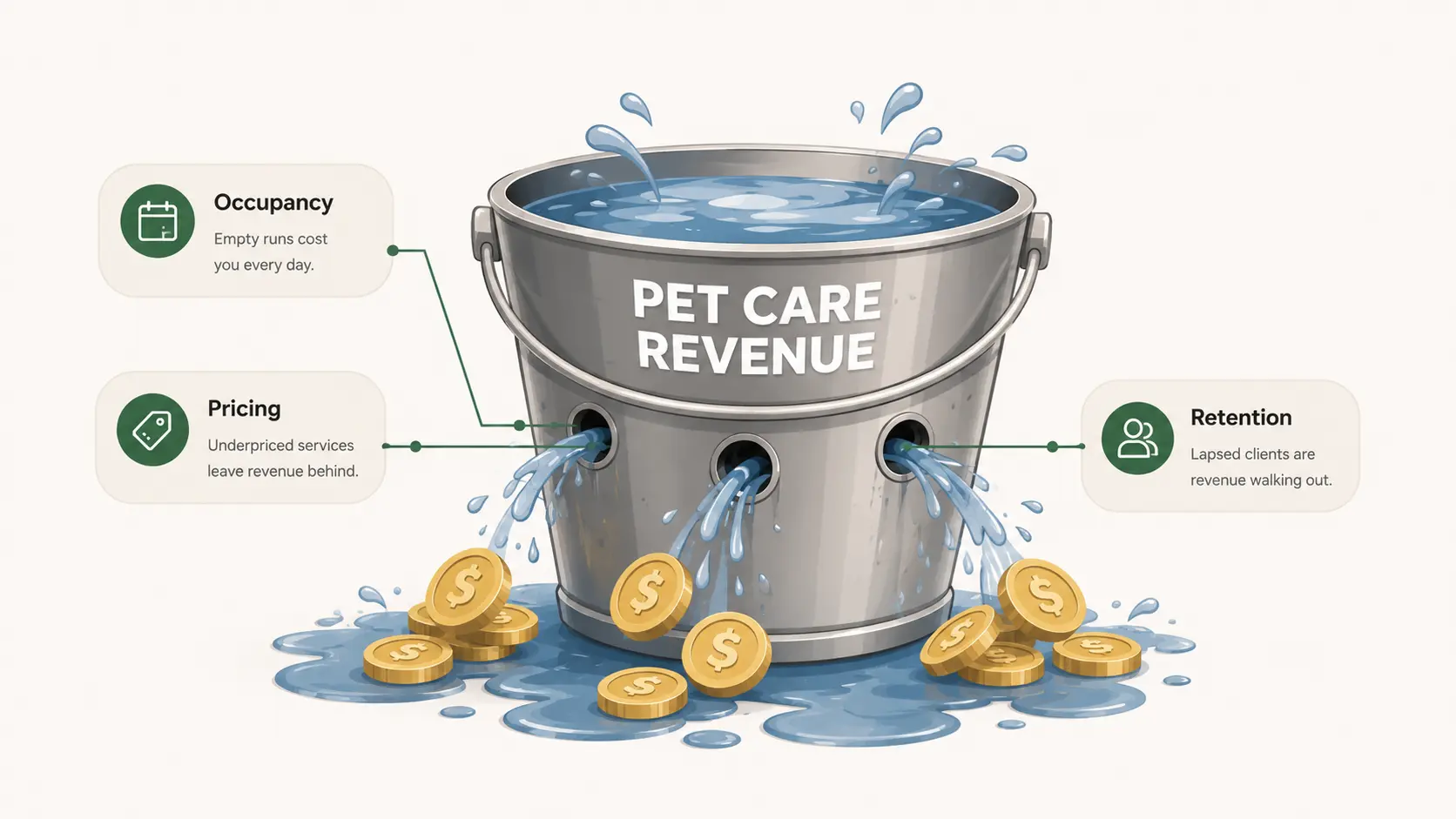
Illustration of a pet-care revenue bucket leaking money from occupancy, pricing, and retention holes
Step 1

Know three numbers before you touch a price

You can't price rationally if you don't know what a night in your building is worth today. Three numbers, all computable from records you already have:

Occupancy rate

Pet-nights sold ÷ pet-nights available. If you're consistently above ~85–90% on peak days, your price is too low — you're selling out something scarce at a discount. Consistently under half full, and price probably isn't your first problem; demand is.

Revenue per pet, per day

Total revenue ÷ total pet-days, add-ons included. This is the number your pricing actually moves. Watch it over time: if it's flat while payroll and rent climb, you're taking a quiet pay cut every year.

Your cost per pet-day

Total monthly operating cost ÷ pet-days delivered. Labor, rent, insurance, utilities, software — everything. The gap between this and revenue per pet-day is your real margin. Most operators have never computed it; the ones who have price with confidence.

These are the same figures in the 6 numbers every kennel should track — and the reason most operators price by copying is that legacy software records every booking but never computes any of this. BarkWhiz's Management KPIs screen hands you occupancy and revenue per pet from your own records, so the "know your numbers" step stops being a spreadsheet project.

Step 2

Structure the menu so upgrades sell themselves

A single flat rate leaves money with every client who would have happily paid for more. The fix isn't tricking anyone — it's giving the people who want more a way to buy it.

Tier the core service

Basic, upgraded, premium — a standard run, a bigger suite, the top-tier stay with extra one-on-one time. Three tiers is plenty. The middle tier does the selling: anchored by the premium above it, it reads as the sensible choice, and a meaningful slice of clients will take the top one anyway.

Make add-ons visible at booking

Exit baths, extra play sessions, photo updates — small per-night dollars that compound across a full house. The operational key: attach them at the moment of booking, when the owner is thinking about their dog's stay — not as an awkward upsell at drop-off. On a self-service booking page, clients add these themselves.

Charge for peak, honestly

Holidays sell out every year — that's scarce inventory, and a posted holiday rate (or holiday minimum-stay) is fair and expected. Post it, apply it consistently, and don't apologize for it. What erodes trust isn't peak pricing; it's surprise pricing.

Reward commitment, not just volume

Packages and memberships trade a modest discount for predictable revenue and stickier clients — usually a better deal for you than blanket discounting. Which one fits your model is its own decision: see packages vs. memberships.

Step 3

Raise prices on a schedule, not in a panic

  • Small and annual beats big and rare. A modest increase every year, announced plainly, barely registers. Waiting five years and jumping 20% because payroll finally forced your hand — that's the increase that loses regulars.
  • Announce it like a professional. A short note a few weeks ahead: the date, the new rate, a thank-you. No three-paragraph apology — you're a business, and your clients' vets, groomers, and sitters all do the same.
  • Grandfather deliberately or not at all. If you protect existing clients' rates, do it as a stated perk with a horizon — not an accident of nobody updating the file. Loyalty pricing should be a decision, not an oversight.
  • Watch the two numbers after. Occupancy and revenue per pet-day. If occupancy holds and revenue per pet climbs, the increase worked. If bookings genuinely sag — you'll see it in weeks, and you'll see it in data instead of vibes.

One honest note on dynamic pricing — rates that move with demand. Done well it's real money on peak weekends; done badly it reads as price-gouging with extra steps. We're building demand-based pricing into BarkWhiz, and we say plainly that it's in development, not live yet — today, a posted peak-season rate applied consistently captures most of the value with none of the software.

Price from your numbers, not your nerves

BarkWhiz computes your occupancy and revenue per pet from your own records, and its catalog handles tiers, add-ons, packages, and memberships — so the structure in this guide is a setup screen, not a spreadsheet.

Not ready for a founding spot? Just keep me posted